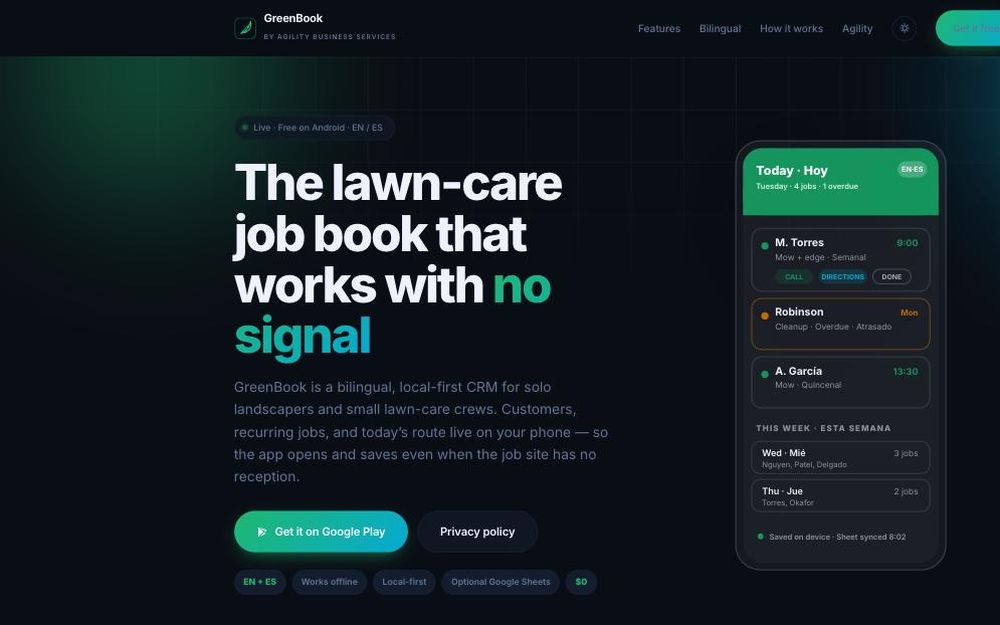
GreenBook
Landscaper CRM · Android
Bilingual, local-first job book for solo landscapers. English and Spanish at one tap, and it opens and saves with no reception — because the job site has none.
I run Commercial Data & Analytics by day, and ship AI products by night.
Twenty years of enterprise-grade constraints. Three live products' worth of consumer-grade polish. The combination is the point — most people have one or the other.
Head down on Quantlys. Always happy to talk about platform, productivity, or developer-facing products.
Each one started from a real problem somebody described out loud, not a gap on a slide. All three are live right now — you can download one, clone another, and call the third. An AI workforce either ships working software or it doesn't; this is the part that isn't a claim.
Bilingual, local-first job book for solo landscapers. English and Spanish at one tap, and it opens and saves with no reception — because the job site has none.
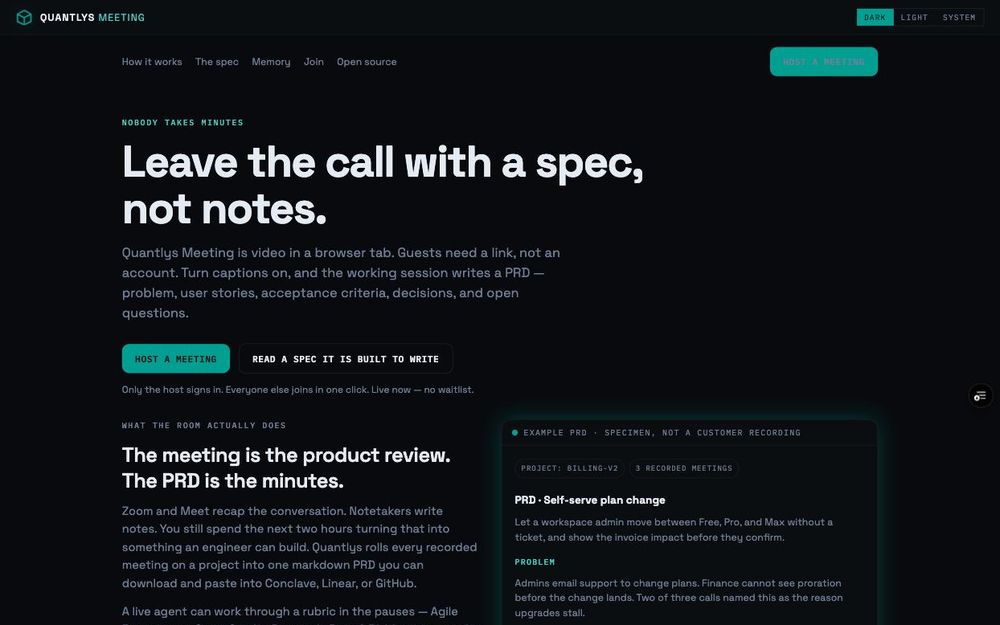
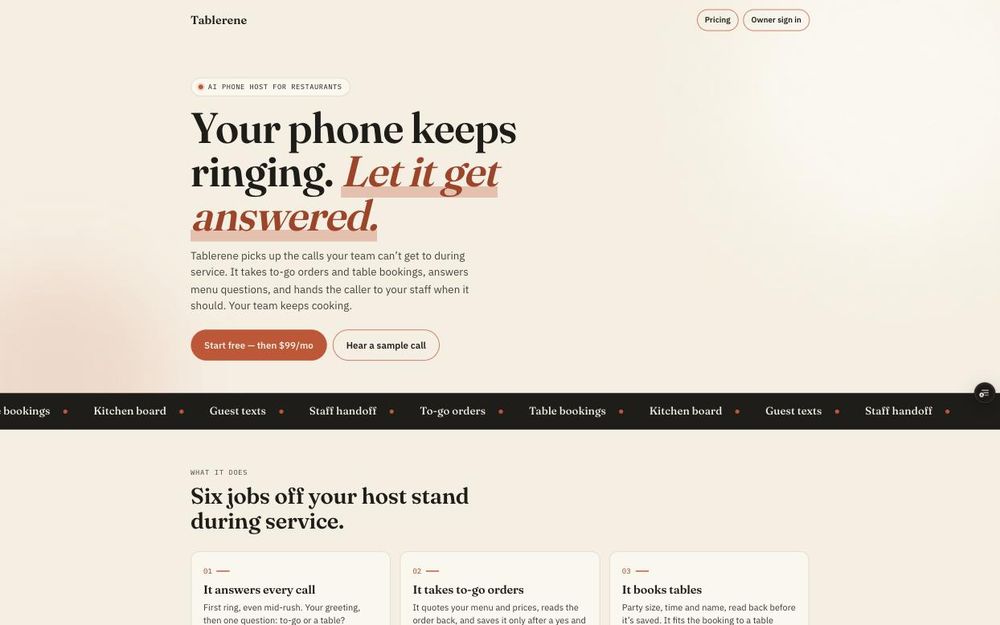
An AI phone host that answers on the first ring while the team runs service. Takes to-go orders, books tables, and hands off to a human for allergy questions instead of guessing.
Pick one. Written answers are available for every question.
Most product people have lived on one side of this line. Either they have shipped things people choose to use, or they have shipped things inside an organisation where governance, audit and procurement decide what is possible. The two disciplines teach opposite reflexes, and the gap between them is where most enterprise AI quietly dies.
I work both sides every week. By day the constraint is real: pharma commercial data, 110+ source systems, governance that has to hold. By night the constraint is equally real and completely different — if a stranger has to create an account before they get any value, there is no product.
What that combination produces is a specific instinct: ship the thing that survives a security review and that someone picks up without being told how. I have had to learn both the hard way, on the same calendar.
Four I'd stake a product on, two I'm solid at, and two I'm still building in the open. Each one links to the work that backs it up.
Taking an AI product from a problem someone described out loud to something people use.
Choosing the right model for each job, and holding every build to a budget.
A team of AI agents and a few humans, with clear lanes and a short list of what only I approve.
Shipping fast without shipping something I can't take back, and saying what still broke.
Phone and video, live: the plumbing behind an AI phone host and a meeting that writes its own PRD.
Let the cost driver set the price. A flat price on a usage-priced product moves the risk onto you.
Now: learning what people actually search for and how to say what Quantlys is in one sentence. This is the skill I'm least likely to hand off.
Now: counting the steps between a stranger and their first win, and deleting the ones that don't earn their place.
Product ownership at Gilead isn't one title for me — it's five concurrent ones, across launches, field tooling, commercial AI and site technology. This is the enterprise half of the thesis, and it is where the constraints live.
Most interested in product roles where enterprise constraints and consumer expectations meet — platform, productivity, or developer-facing. Also happy to compare notes with anyone building solo.